








「世界を新しく作り変えることができたら?」親愛なる BLESS からのレター
BLESS
interview & text: sakiko fukuhara
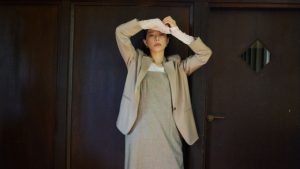
「BLESS (ブレス) は私たちにとって、レーベルでもブランドでもアートコンセプトでもありません。それは互いに向き合い、それぞれの関心が交差する場所です」。ベルリンを拠点にする Ines Kaag (イネス・カーグ) と、パリを拠点にする Desiree Heiss (デジレー・ハイス) が BLESS をスタートしたのは1995年。「まるで長い結婚生活のように」続けてきた二人のリレーションシップは、変わらない美学のもと、日々生まれるアイデアを更新し続けてきた。
──衣服とそれを取り巻く環境に「批評性」をもつこと。不一致が導く好奇心。クリエイティブとビジネスの境界線をなくすこと。──そのアティテュードを持続するためには?と尋ねると、「忍耐強くあること」という実直なメッセージが返ってきた。多くの人と携わり、コミュニケーションを交わし、共に歩みながら、私たちに「ある生き方」を提示してくれる BLESS。ひとつの「有機体」として活動を続ける BLESS は、今日も私たちに新しい視点と知恵を投げかけてくれる。
「世界を新しく作り変えることができたら?」親愛なる BLESS からのレター
Portraits
—ウィーンで学んでいたデジレーと、ハノーファーで学んでいたイネス。二人はどのように出会い、「BLESS」というレーベルを始めることとなったのでしょうか?
1993年、私たちはパリで開催されたファッションコンテストで出会いました。お互いの作品が隣同士に展示されていて、とても興味深く感じたのを覚えています。特に、それぞれ異なる教育的背景を持っているところに惹かれたんです。そこから住所を交換して、私たちの友情が始まりました。最初の会話はたった3分ほどでしたが、お互いに何か通じ合うものを感じました。出会いからすぐに何か大きな出来事が起きたわけではありませんでしたが、文通を重ねるうちに、友情へと発展していきました。それは言葉よりも、ビジュアルを通しての交流でした。イメージを交換することでお互いを知っていったんです。「元気?」「私は元気だよ」といった文字のやり取りよりも、ポストカードにはメッセージを書くスペースが限られていたので、選んだイメージそのものを通してコミュニケーションを交わしていました。
その後、私たちはそれぞれの卒業制作発表を訪れ、双方のプロジェクトの成功において大きな影響を与え合いました。卒業後も交流はさらに活発になり、ファッション業界で仕事を見つけるまでの間、何かを創り続けようと活動を続けました。しかし、その「仕事」はついに訪れませんでした。代わりに誕生したのが BLESS です。そのきっかけとなったのは、i-D 誌に掲載した「BLESS N°00 Furwigs」の広告でした。この広告が Martin Margiela (マルタン・マルジェラ) の目に留まり、彼は1997-98年秋冬コレクションのショーのために、私たちに一連のウィッグ制作を依頼しました。そして、その契約に署名したことが BLESS の設立へとつながったのです。このエピソードは、BLESS が当初からブランド設立を目的として始まったのではなく、二人の継続的な対話と実験的な創作活動の延長線上で自然発生的に誕生したことを象徴しています。特に「BLESS N°00 Furwigs」は、のちにブランドの出発点として語られる象徴的なプロジェクトとなりました。
—離れた都市で暮らすお二人は文通を通して、コミュニケーションを交わし、その体験から、毎コレクションにはポストカードが添えてリリースされることになったそうですね。現在に至るまで、一人ではなく、二人だからこそ生まれた視点はありましたか?
何かを二人で始めるという、その事実が BLESS を誕生させました。BLESS は私たちにとって、レーベルでもブランドでもアートコンセプトでもありません。それは互いに向き合い、それぞれの関心が交差する場所です。私たちは当初から、BLESS と呼ぶものは一人では決して生み出せなかったものだと考えていました。
異なるヨーロッパの都市で暮らしてきたことで、それぞれの文化的背景の違いは時間とともに明確な形となって現れました。その違いは、より広い視野に基づく複雑な対話を生み出し、時には摩擦を伴いながらも、より豊かな議論へと発展していきました。現在では、お互いの関心が異なる方向へと向かうこともあります。しかし、それは長い結婚生活の末に見られるような関係の断絶にはつながりません。むしろ、そのような不一致は新たな好奇心を生み出し、さらなる対話や交渉へと発展していきます。そして最良の場合は、作品という形で発表される、より成熟した表現へとつながるのです。
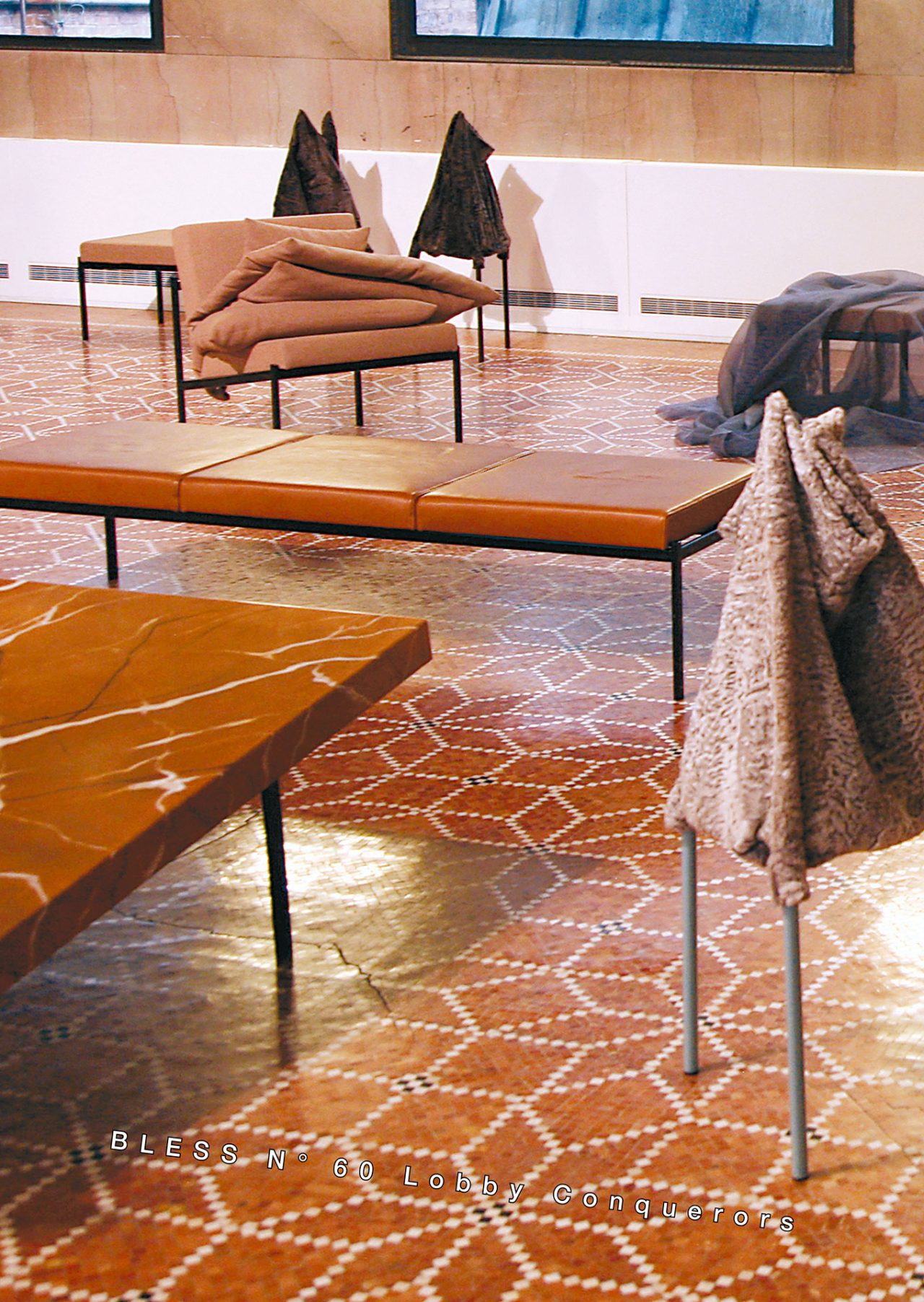
Photographer: BLESS
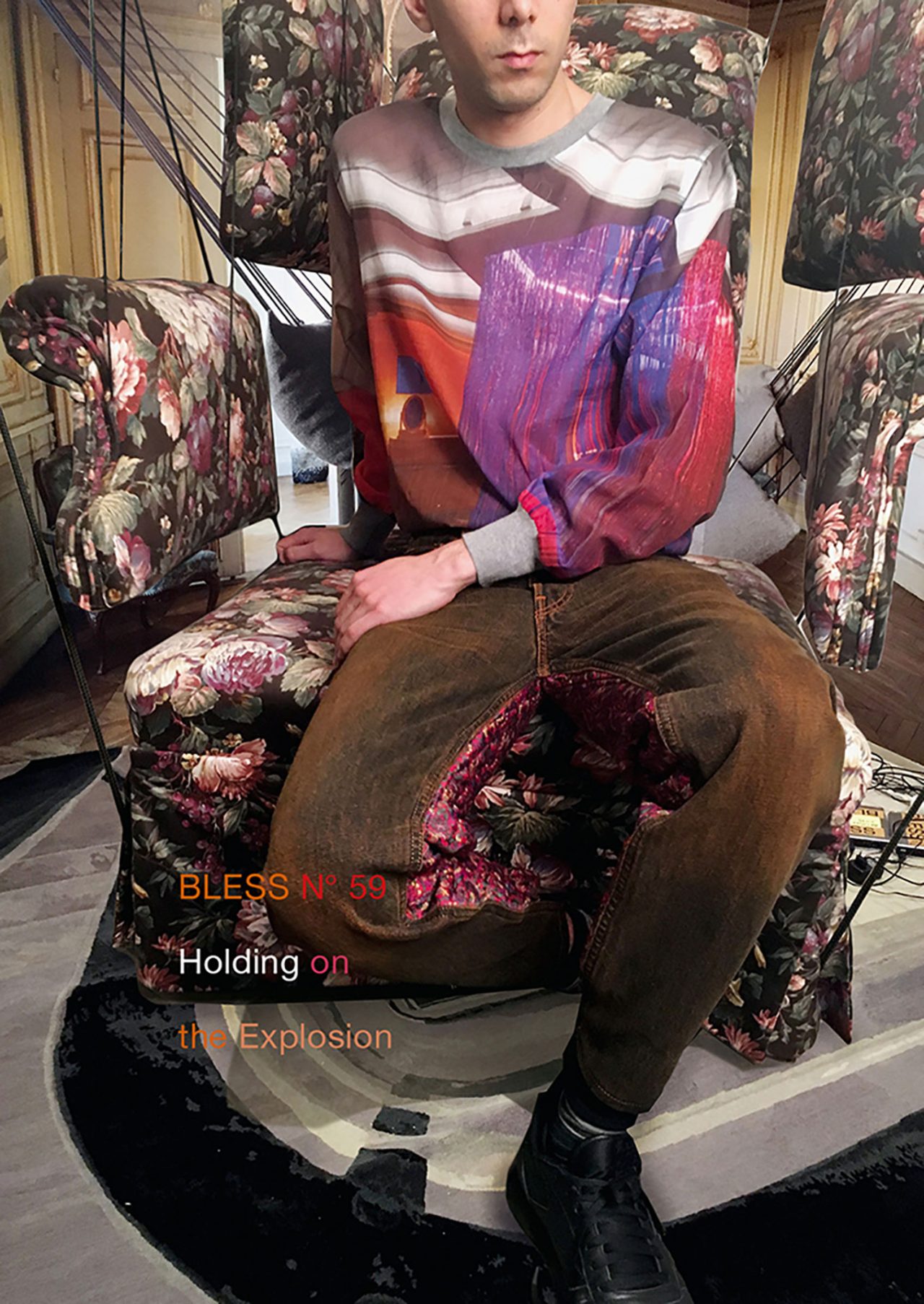
Photographer: BLESS
—1995年の設立時は「ファッションデザイナーにはならない」という決意を固めていたとある記事 *1で読みました。当時のファッションシステムに感じていたことを教えてください。また、お二人があえて「ファッション」を表現の入り口として選んだのは?
私たちはファッション業界そのものや、ランウェイショー、モデル、グラマーな世界観、目まぐるしい流行といった業界特有のコードには関心を持っていませんでした。そして今もなお、その姿勢は変わっていません。
私たちが関心を寄せているのは、衣服そのものです。衣服は日常生活の中で非常に個人的で直接的な存在であり、誰にとっても避けることのできない影響力を持つものだと考えています。そして、その関心は自然と衣服を取り巻く環境へと広がっていきました。人々の内面的な生活から外面的な生活に至るまで、暮らしを構成するさまざまな要素にも興味を持っています。
—創作を続ける中で、お二人の役割はどう分担されているのでしょうか?
Everyone is doing everything (全員がすべてのことを行う)。二人の間に役割の分担はないということです。会社も二人で築いてきましたし、プロジェクト、デザイン、コレクション構成、そしてビジネスに関する意思決定まで、すべて一緒に行っています。二人の間だけでなく、クリエイティブとその他のビジネスの間にも境界はありません。私たちにとって、それらは別々のものではなく、完全にひとつのものなのです。
私たちが試みているのは「職業」という概念そのものを捉え直すことです。単なるファッションカンパニーではありませんし、常に新しいものを生み出すことに執着しているわけでもない。アートでもなければ、経済的な意味でのブランドでもない。進む方向は、経済状況を含めたさまざまな環境によって絶えず変化していきます。私たちはひとつの有機体 (organism) のように、たくさんの人と関わりながら、ただ一緒に進み続けています。
25年以上続けてきましたが、経済的に非常に大きな成功を収めたというわけではありません (笑)。でも、その代わりにその自由を守り続けてこれた。私たちにとって BLESS は、ファッションというよりも、生き方 (lifestyle) に近いものなんですよね。
—1995年夏、さまざまな女性のコラージュポスター (謎めいた電話番号を添えて) がウィーンの街に張り巡らされ、BLESS のデビューが知らされました。その年発表されたのはバストトップだけが見事に隠れる透明の「サン・トップス」でしたね。「サン・トップス」が生まれた背景について、また当時のアクションをご自身たちでどう振り返りますか?
特に大きな理由があるわけではありません。私たちは、通常は布地のギャザーを寄せるために内側で見えないよう使われる、透明なストライプ状のウエストバンド用ゴムの美しさに単純に惹かれていました。それらを縫い合わせることで、本来の用途から切り離し、新たな素材として再解釈しました。小さなパーツだったものは広い面積を持つ一枚のファブリックへと変化し、その仕上がりは、当時私たち自身が外出時に着たいと思う服のイメージと重なるものでした。
また当時、すでに時代遅れになりつつあったラミネート式の ID カードや社員証のようなものを作る機械がありました。その機械から着想を得て、モデルの顔を切り抜いたモチーフを制作し、それを複写のプロセスによって自分たちの頭部の代わりとして身体に配置するアイデアが生まれました。そして私たちは、その発想をさらに自由に発展させながら実験を重ねていったのです。
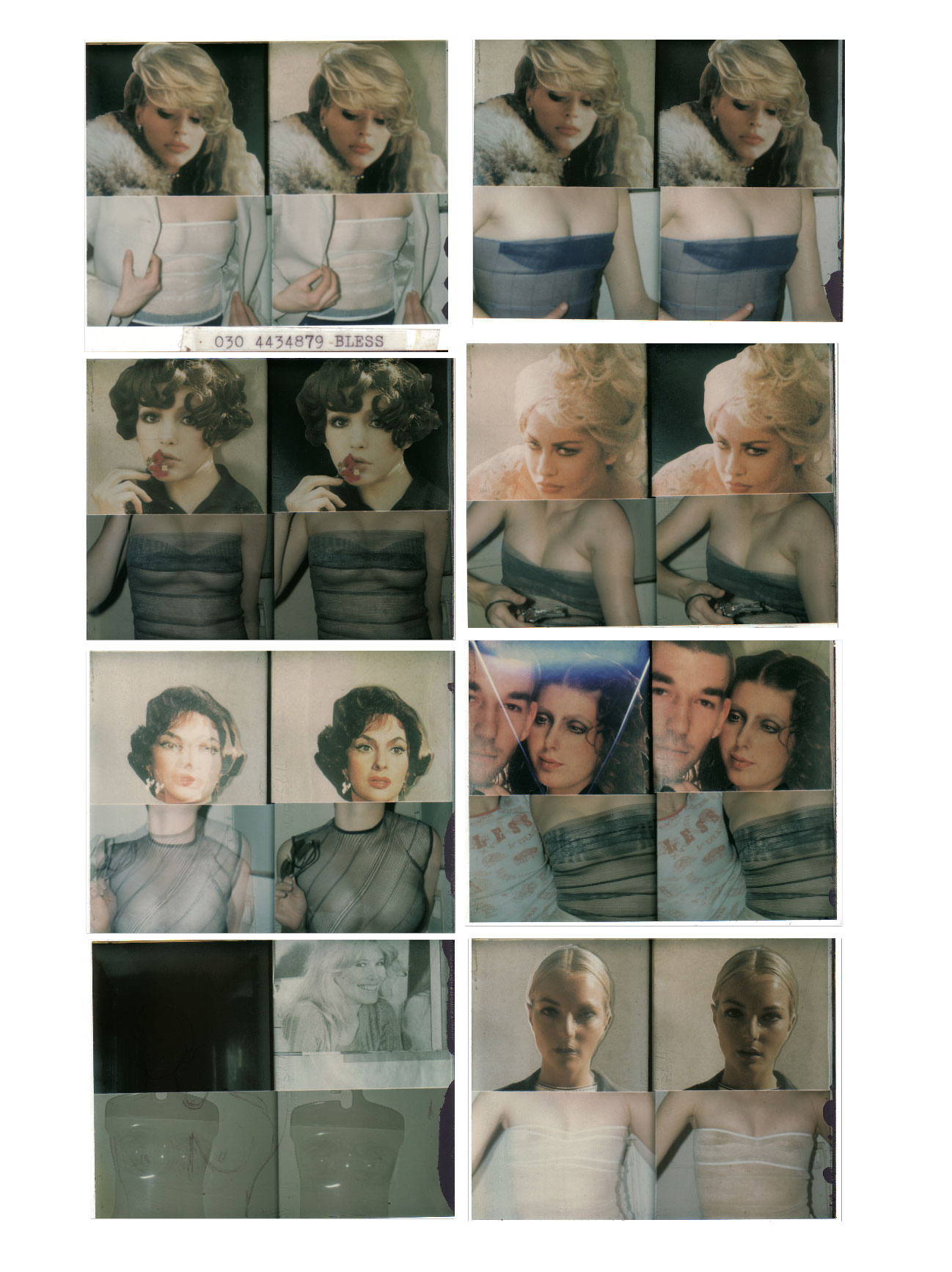
BLESS Debut / 1995, Photographer: BLESS
—翌年発表された「Furwig (ファーウィッグ)」はいくつかのファッション誌に広告という形で姿を現し、それを見た Martin Margiela が自身のショー (97/98 AW) のためにこのウィッグの制作を依頼したことも、語り継がれるエピソードです。この作品はどのように生まれたのでしょう? また、BLESS を語る上で欠かせない「コラボレーション (協働)」が自然発生的に生まれたことも興味深いです。
イネスの父親は毛皮職人だったため、彼女の家には常に毛皮の端材や素材のストックがありました。ファッションスクールを卒業した後、初めての「コラボレーション・バケーション」として一緒に過ごしていた際、私たちはお互いが持ち寄ったさまざまな素材の残布や端材で遊びながら実験を重ねていました。
その過程で生まれたのが、ファーウィッグです。それは私たち自身にとっても、どこか見慣れず奇妙な存在として感じられるプロダクトでした。私たちがそれに強く惹かれたのは、そのアイテムが当時目にしていた何かや、実際に身に着けていたものをまったく連想させなかったから。既存のファッションやアクセサリーの文脈には収まらない、未知で新鮮な存在として映ったのです。
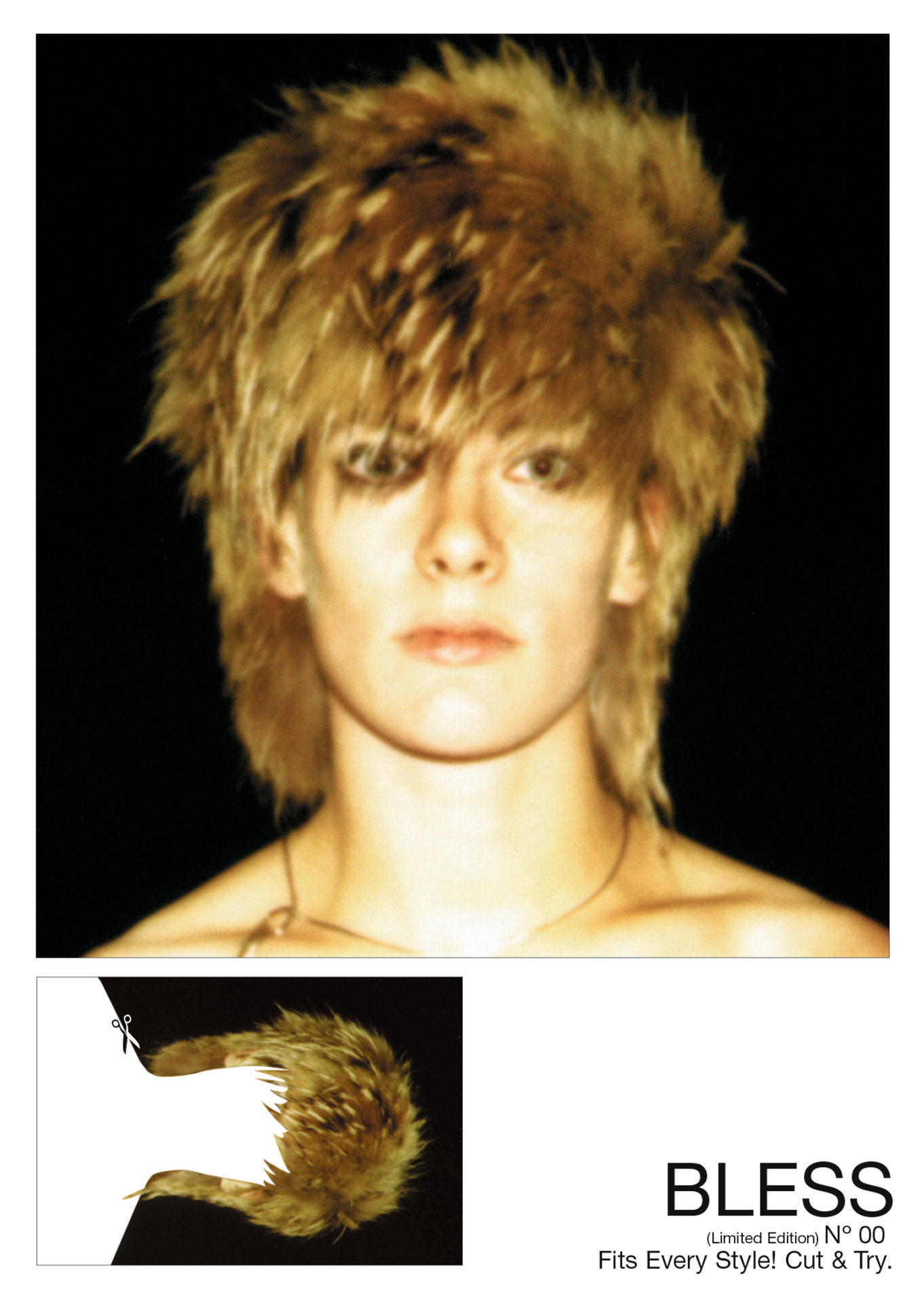
BLESS N°00/ Furwigs / 1996 Photographer: BLESS
—また、お二人はデビュー時から一貫して、公の場で顔を見せない姿勢を貫いてきました。取材記事の中で、ポートレートではなく、BLESS の製品を使用するように説得するため、「BLESS N° 09 Merchandising Stitched Starcut T-shirt」が生まれたといいます。当時の提案についてもう少し詳しく教えていただけますか?
メディアからポートレートを求められた時、いつも掲載を断り、代わりに自分たちのプロダクトを載せてもらおうとしていました。活動を始めた頃から、有名になることにはまったく興味がなかったんです。ただ、プロダクトやクリエーションを作りたかった。なぜ作り手自身ではなく、仕事やクリエイティブのプロセス、作品そのものに関心が向けられないのだろう、と疑問に思っていました。だから、プロダクトを送って、「これを掲載してください。これこそが私たちを表すものです」と伝えていました。
N°09では、顔を見せることを拒んでいるという事実自体を逆手にとり、アイデアとして活かすことにしました。それは同時に、クリエーションの裏側にいる人の顔ばかりを常に見せようとするメディアのあり方への批評でもありました。顔を出さなかったのは、ただ恥ずかしかったからではありません。顔を見せないということに対して、ある意味とても頑固だったんです。
Martin Margiela も同じように顔を見せることを拒んでいましたが、私たちが活動を始めた当時、デザイナーデュオやチームという考え方はまだ一般的ではありませんでした。常に「一人のデザイナー」という存在が中心だった。ですから、私たちが二人で活動しているということ自体が、自然とオルタナティブな存在へと導いていきました。そこから「BLESS」という架空の人物を作り出したんです。「これが私たちです」と言ってしまうことは簡単でしたが、この拒否の姿勢を起点に考えを発展させることの方に意味がありました。
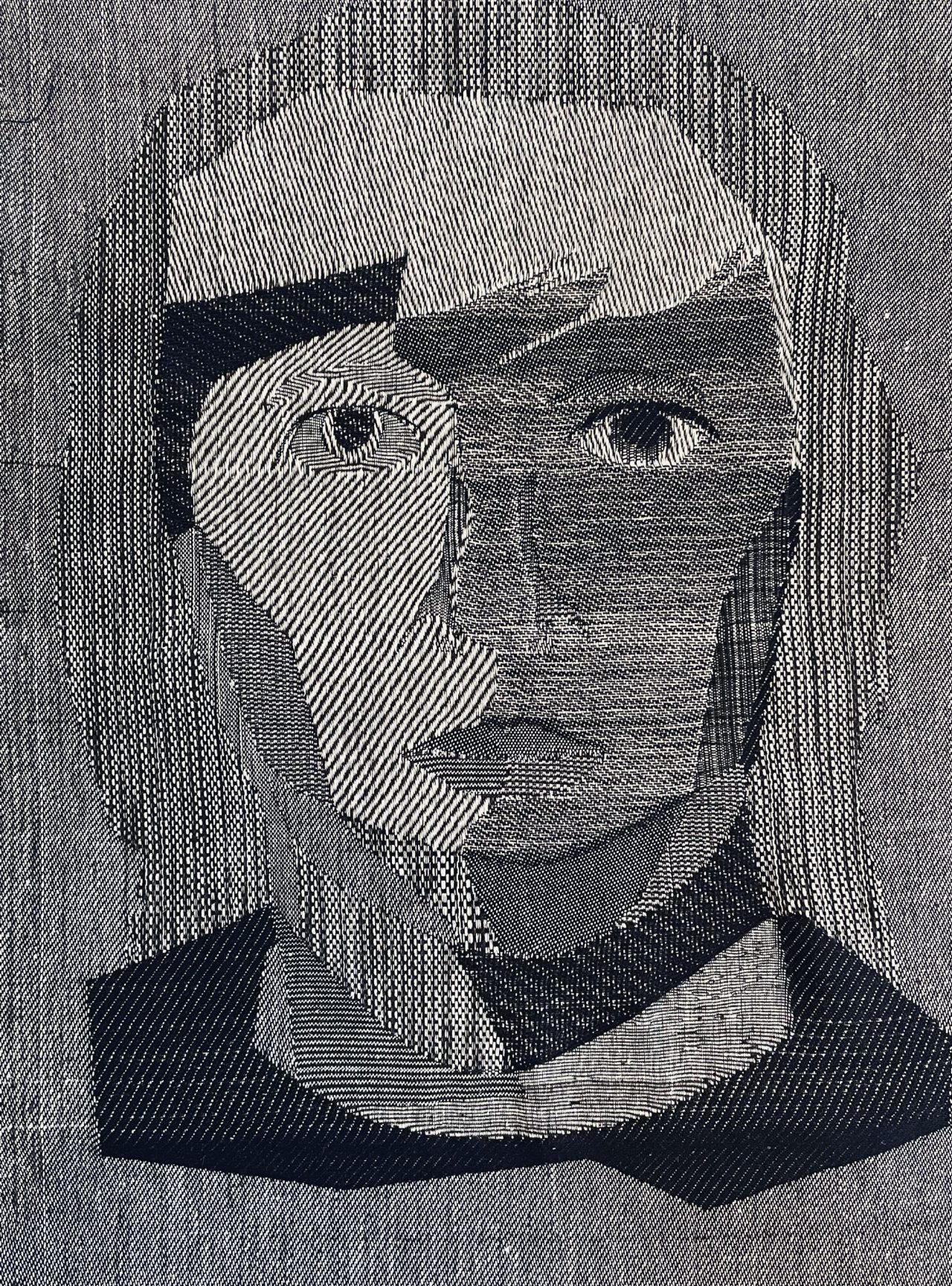
人々は、架空の人物である「BLESS」に興味を持つようになりました。私たちがしていることはコミュニケーションであり、外の世界とつながることこそがモチベーションなんです。そこで「Tシャツを作ろう」と考えました。顔写真を依頼してきた記者に向けたものとして終わらせることもできましたが、もっと多くの人に届くものにしたかった。そこで、ポートレイトを描くというアイデアが生まれました。ただ自分たちの顔をプリントするのではなく、自分たちの考えから生まれた「顔の抽象的なビジョン」として表現したんです。
こうして N°09 が生まれました。その後、このアイデアは何度も形を変えて展開されていきました。4、5年ほど前には、このコンセプトをステッチのラインで再び表現し、20年前の二人の顔でありながら、アップデートされたものになりました。表と裏を入れ替えたり、さまざまなバリエーションを作ったり、あえて混乱を残すように仕上げました。20年前は、それぞれ別々の一人の人間でしたが、一緒に活動していく中でとても密接な存在になり、日々の生活も自然とつながっていきました。長い結婚生活のようでもあり、二人の間に子どもが生まれるような感覚にも近かったんです。このポートレートは、まさに私たち二人の顔が混ざり合ったものになりました。もはや、二人の「子どものポートレート」のような存在ですね。
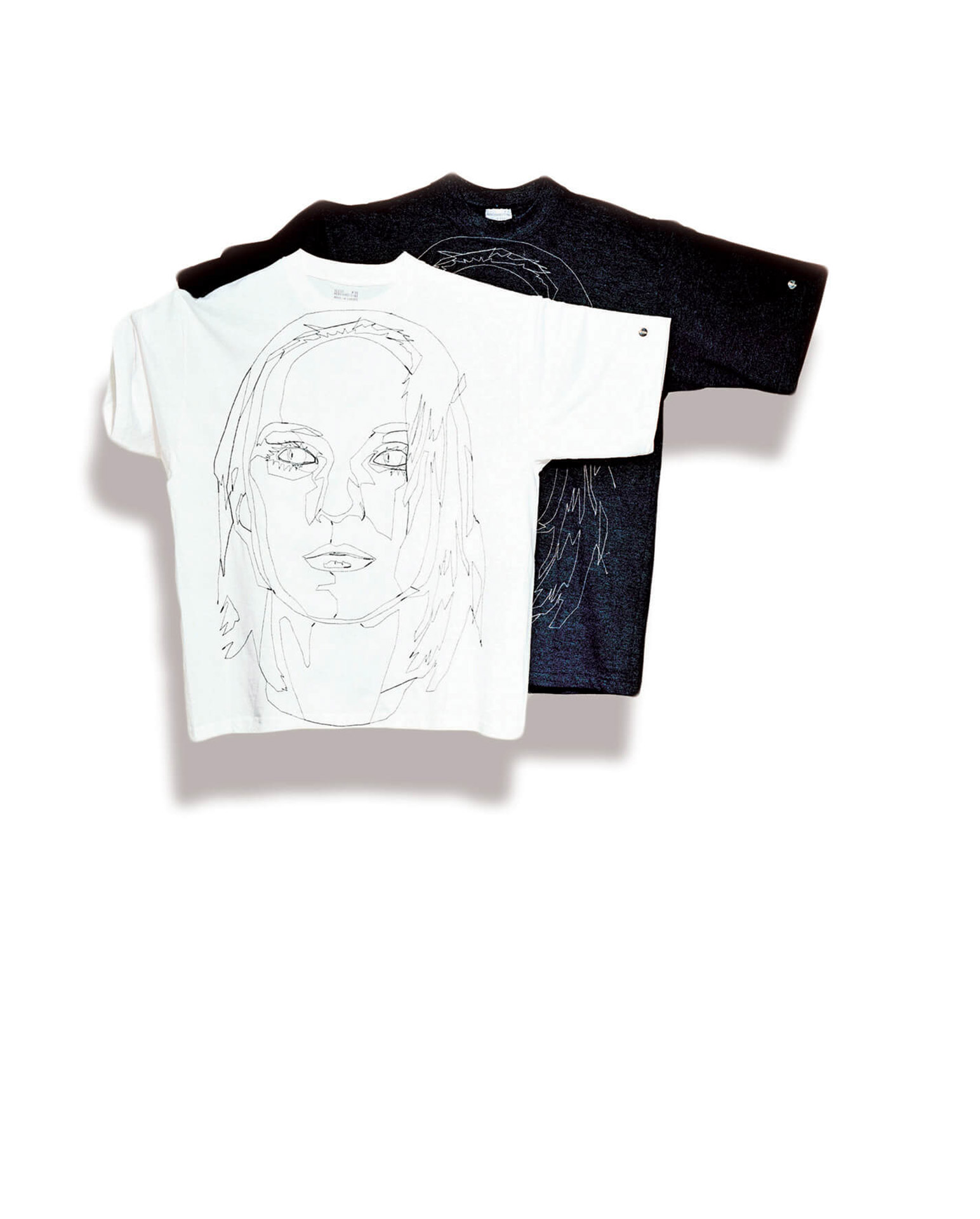
BLESS N° 09 / Merchandising Stitched Starcut T-shirt / 2012, Artist of the illustration: HENDRIK HELLIGE
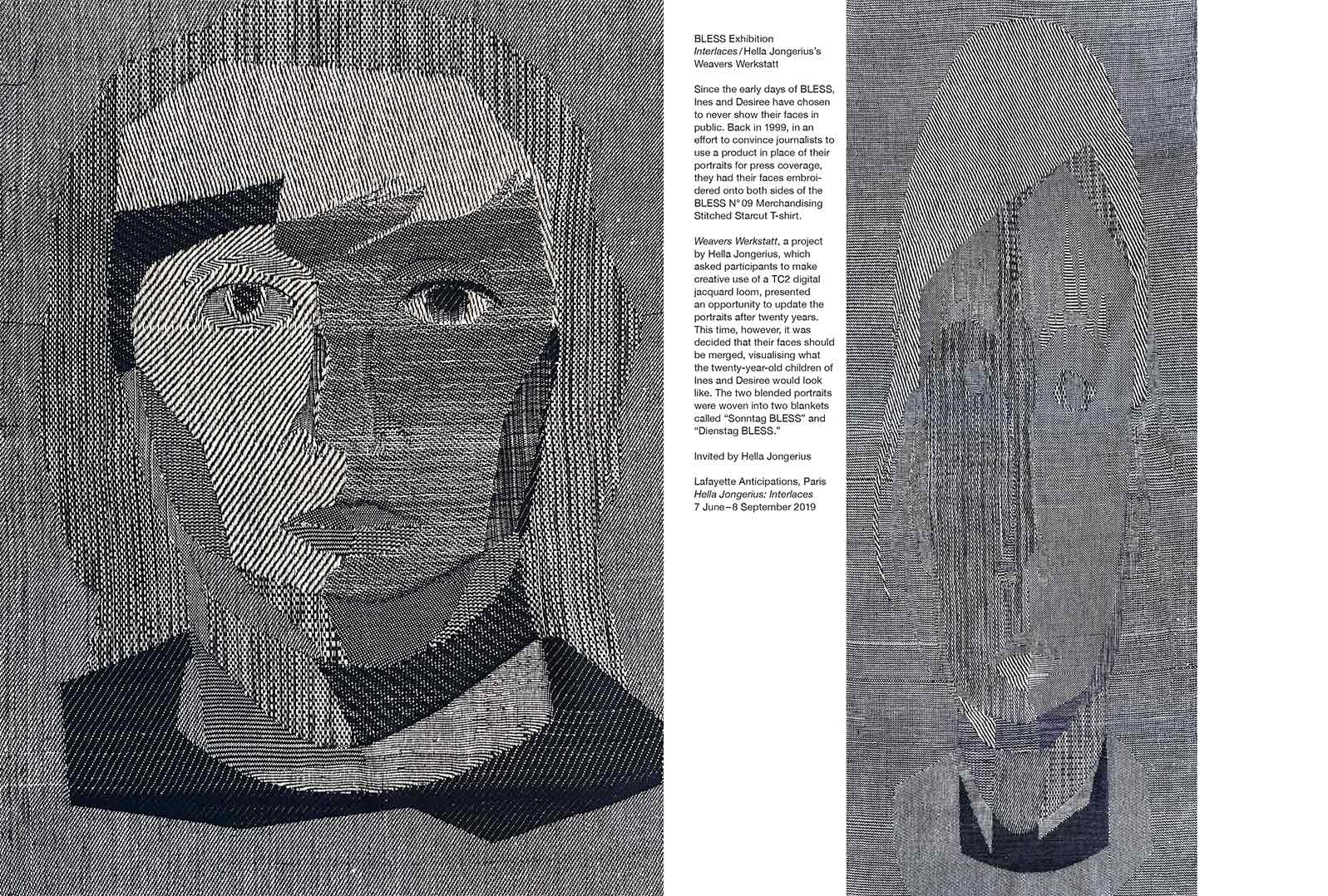
Sonntag BLESS / Dienstag BLESS Invited by Hella Jongerius Hella Jongerius: Interlaces, 7 June-8 September 2019, Photographer: BLESS
—「Furwig」をN°00とし、以降発表されたプロダクトはナンバリングされ、2026年でN°82になります。デビュー時より貫く「ナンバリング」というメソッドについて教えてください。そして過去に発表されたアイテムに少しの手を加え、継続してラインナップすることで、服を余らせず、オーガニックなものづくりをされてきました。また、N°100で完結するというコメントも目にしましたが、「ナンバリング」には終わりがあるのでしょうか?
私たちはただ始めただけです。とても実践的で分かりやすい方法として、BLESS のナンバリングをN°100で終えることに決めました。とはいえ、その終わりがいつ訪れるかは私たち次第です。ひとつの BLESS ナンバーにどれだけ多くのアイテムを含めるか、あるいは1年にいくつのナンバーを発表するかによって、そのスピードは大きく変わります。
現在は、N°83の制作に取り組んでいます。もし1日にひとつずつ新しいナンバーを発表すれば、17日後には終わりを迎えることになります。しかし、10年にひとつしか発表しないと決めれば、その終わりははるか先になる。あるいは、どちらかが活動をやめたり、この世を去ったりすれば、その時点で終わりが訪れるかもしれません。BLESS の本質は、私たち二人が形づくってきた DNA の中にあります。それでも私たちは、少しずつ近づいてくる「終わり」と戯れることを楽しんでいます。そして、その時に備えるための準備も続けています。
—N°100で終えることを決めた後、お二人の中でポジティブな変化はありましたか?
私たち自身が、その意味を実感しています。N°100という上限を設けたことで、残された数には限りがあると意識するようになりました。だからこそ、この人生の中で自分たちが本当に伝えたいことは何なのか、そこにしっかりと焦点を当てることができたんです。あれもこれもと少しずつ手を広げ続けることはできません。だからこそ、これからどんなテーマに取り組んでいきたいのか、より主体的に、クリアに考えるようになったと感じています。
もうひとつの側面についてお話しすると、私たちはウェブサイトをアップデートして再構築することにしたのですが、それは、ある種のアーカイブの整理になりました。すべてのナンバーが美しく並んでいるのを見た時、初期の頃にこのナンバリングシステムにして本当によかったと感じました。整理もしやすくなりましたし、物事にクリアな構造を与えてくれたのです。そして、数字について考えた時、2桁しか使っていないことに気づきました。だから、このシステムを本気で受け止めるのであれば、どこかの時点で終わりを迎えることになると。
1997年にスタートした時、ある程度計算はしていました。当時27、28歳だったので、N°100に到達する頃には60歳を超えていることになる。もしかしたらそこまで辿り着かないかもしれないと思っていましたが、今ではその数字もそこまで遠いものではなくなっています。N°70を超えた時、「これらが私たちがやってきたことで、これがこれからやるべきことなんだ」と感じました。実現できるタイムラインのように思えたし、とても大きなモチベーションになりました。
自分たちがもっと続けていきたいと思う粘り強い人間だと気づきました。それは外からはなかなか見えない部分でもあったので、それを数字として可視化したかったんです。また、違うやり方で制作をしていると、すべての素材やアイデアが「大きな泡」のように膨らんでいって、ときに息苦しく感じることもあります。「うわ、最悪だ。多すぎる!」って (笑)。だから、一度それらを整理することにしました。最終的に余分なものがなくなっていくと、とても気持ちがいい。人生とはそういうものなのだと思います。
—3冊の作品集、そしてウェブサイトにおいても、デビュー時から現在まで、完璧なまでに作品がアーカイブ化されています。お二人が考えるアーカイブの重要性について教えてください。
現時点では、私たちはまだ制作と記録のプロセスの途中にいます。外から見るとアーカイブのように見えるかもしれませんが、それはむしろ、私たちが必要としているルールや構造を与えようとする試みです。その点において、初期から続けているナンバリングシステムは大きな助けとなっています。
私たちは主に自分たちのために作品を整理し、記録しています。何を制作してきたのかを振り返り、必要なときに見つけ出せるようにするためです。おそらくそれが、私たちのウェブサイトが常に工事中のような状態に見える理由でもあります。ウェブサイトは完成されたアーカイブではなく、今もなお更新や整理が続く、進行中のプロジェクトなのです。
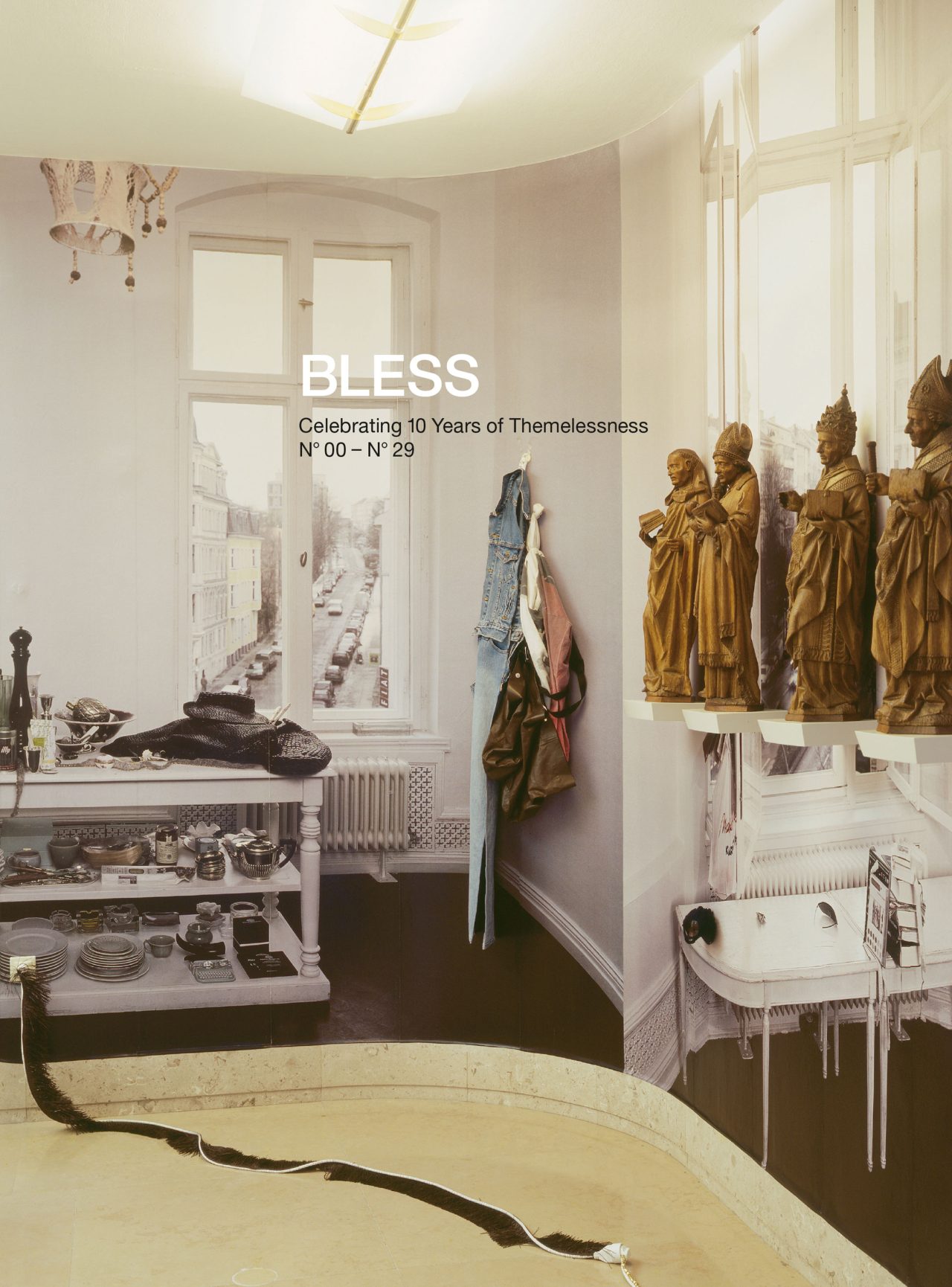
BLESS: Celebrating 10 Years of Themelessness N°00–N°29 (Sternberg Press / 2006), Photographer: BLESS
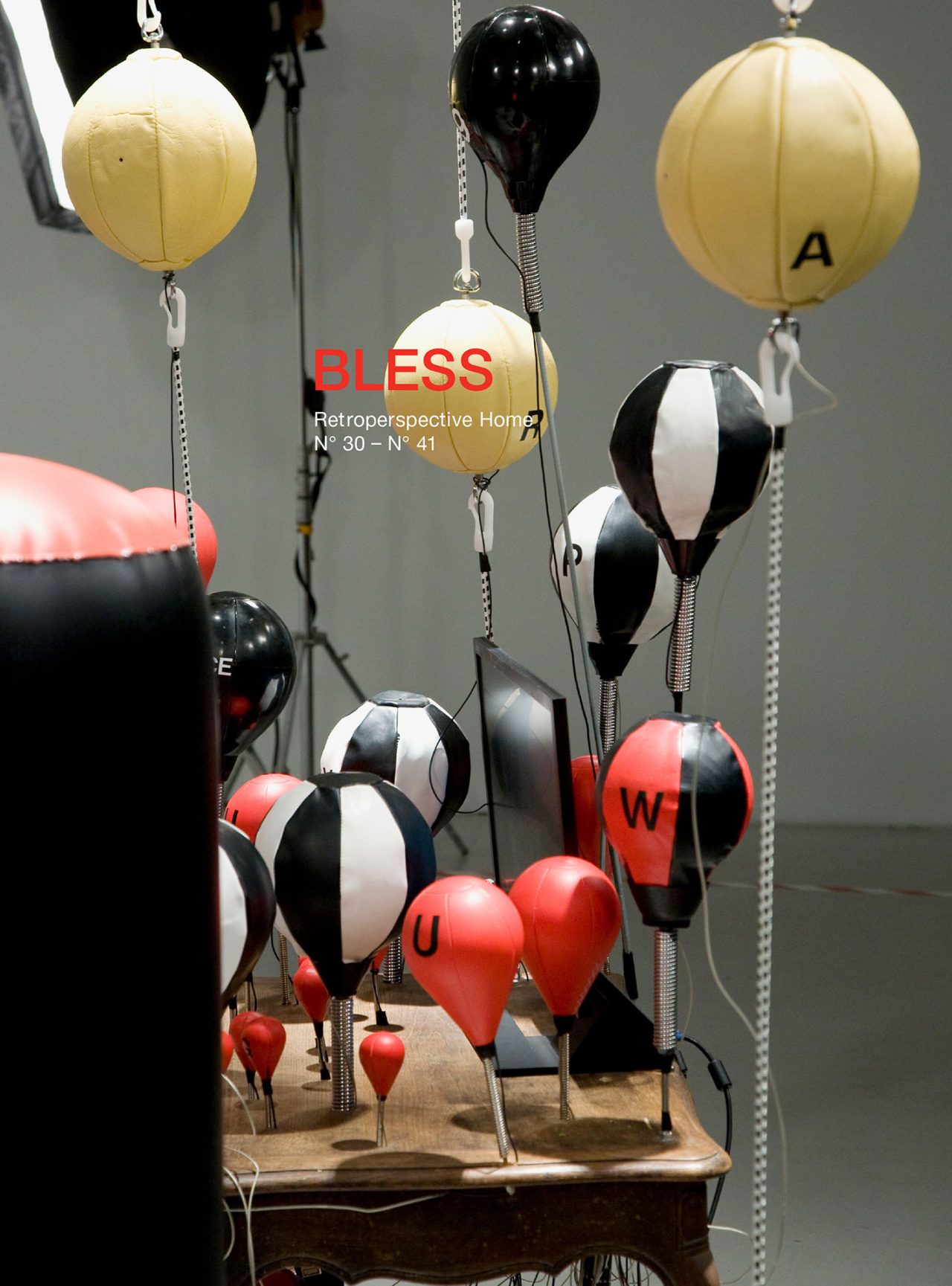
BLESS: Retrosperspective Home (Sternberg Press / 2010), Photographer: BLESS
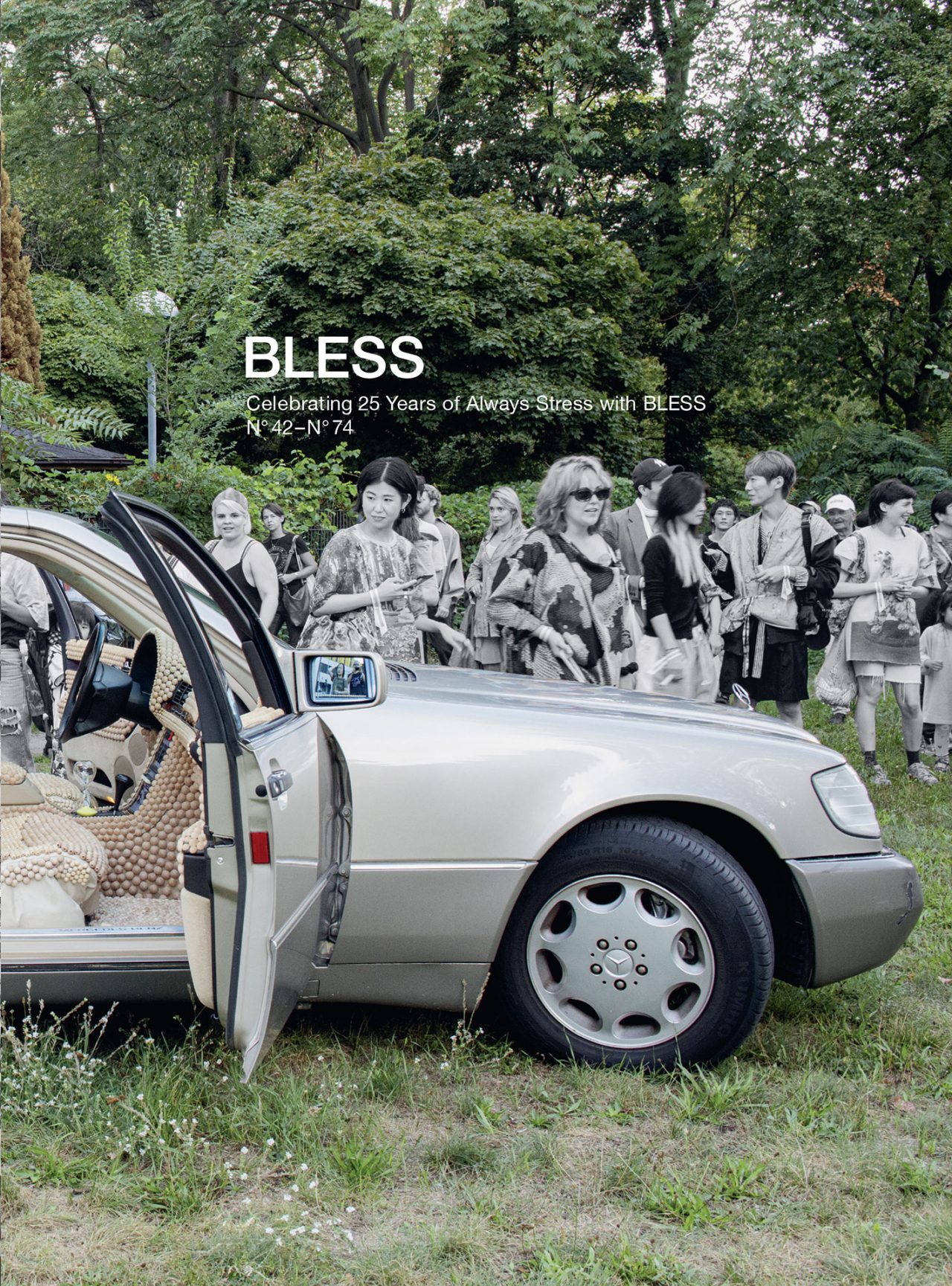
BLESS: Celebrating 25 Years of Always Stress with BLESS N°42-N°74 (BOM DIA BOA TARDE BOA NOITE / 2023), Photographer: BLESS
—世の中のスピードに惑わされず、時に立ち止まり、自分たちの価値観を継続して守っていくこと。言葉にすることは簡単ですが、誰しもが達成できることではありません。BLESS のアティテュードに共感する読者に向けて、なにかヒントになることがあれば教えてください。
アドバイスできるようなことは特にありません。私たち自身、常に自分たちの期待に応えようともがき続けているからです。そのなかでも、「忍耐強くあること」は最も難しい課題のひとつです。しかし、もしそれが報われたなら──もちろん、それが保証されているわけではありませんが──そのときに得られる静かで深い充足感は、何ものにも代えがたいものです。
—BLESS のコレクションでは“日常のある情景”がフォトプリントで表現されることが多くあります。お二人のクリエイションにとって、「写真」はどのような役割を担うのでしょうか? 2000年代にインデペンデントマガジンで発表された BLESS が撮る「BLESS photography」シリーズについても教えてください。
私たちにとって写真というメディアは、しばしば「教科書通りのデザイン」に代わる手段として機能しています。というのも、私たちは新たに何かを生み出すよりも、すでにそこに存在しているものを活用しながら制作することを好むからです。私たちは自分たちの現実を撮影し、それを再生産することで、さまざまな表面やプロダクトの装飾として用いています。
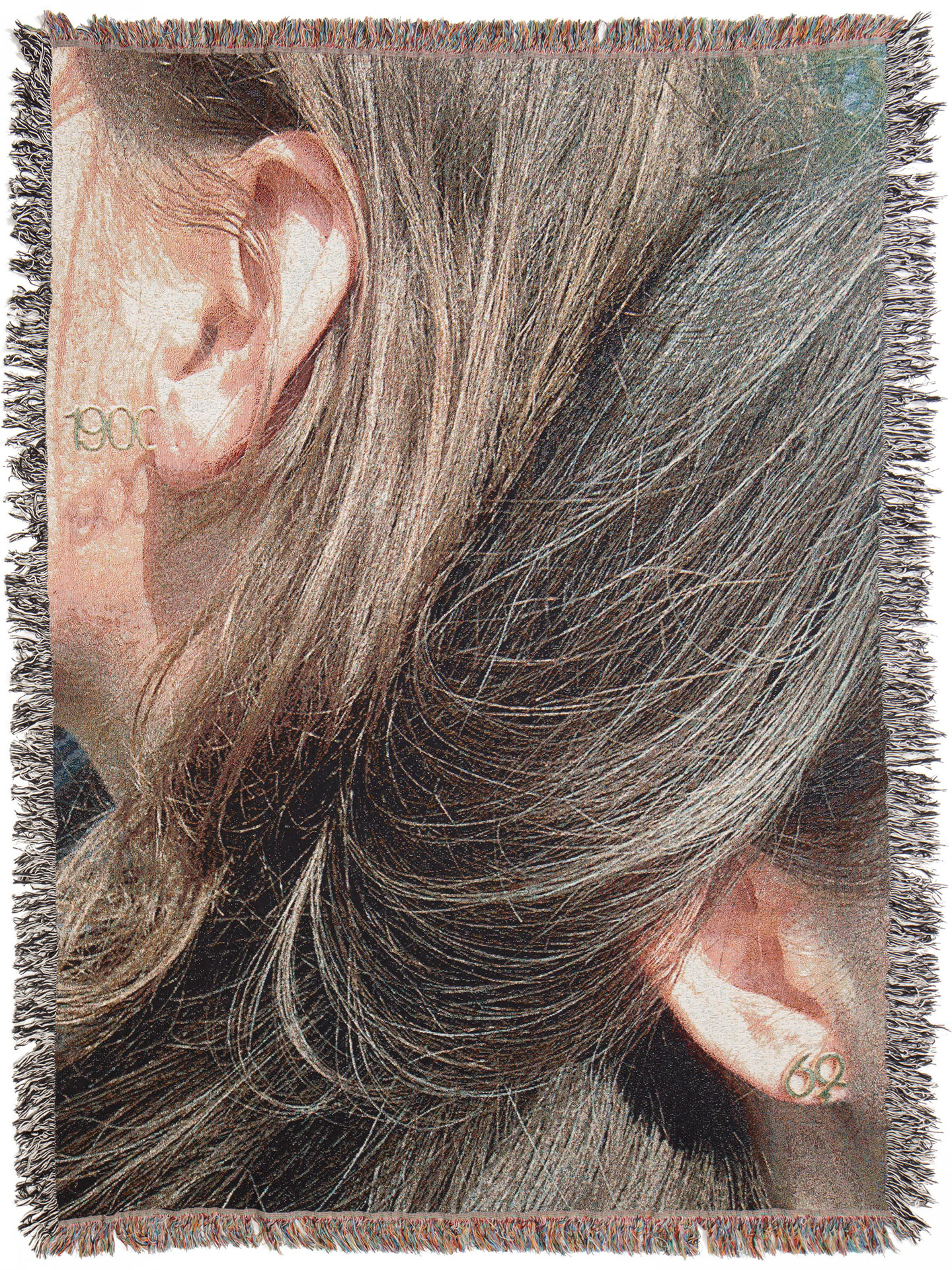
また写真は、アーカイブの手段でもあります。同時に、私たちの「Wallscapes」や「Blankets」に見られるように、遊び心のある表現方法でもあります。「Wallscapes」は、実際の生活空間の中でプロダクトを見せるために制作されるものであり、複数の要素が偶然的かつ自由に組み合わさるシュルレアリスムの手法「カダーヴル・エクスキ (優美な死骸)」を思わせる側面をもっています。一方の「Blankets」は、特別な出来事や空間演出、インスタレーションなどを記録する役割を果たしています。つまり写真は、私たちにとって記録であると同時に、現実を再構成し、新たな物語や風景を生み出すための創作ツールでもあるのです。
私たちは今でも、自分たちが手がけてきた写真シリーズをとても愛しています。そして実際、写真家として活動することも考えたことがありました。現在でも「Poster Book」のための写真は自分たちで撮影していますが、今は時間的な余裕が限られているため、その活動に十分なエネルギーを注ぐことができていません。とはいえ、写真という表現が私たちの活動から完全に消えたわけではない。むしろ、将来的には再びこの側面がより大きな形で現れてくる可能性もあると考えています。写真は BLESS にとって単なる記録手段ではなく、長年にわたって大切にしてきた創作の一部であり、今後再び重要な役割を担うかもしれない表現領域なのです。
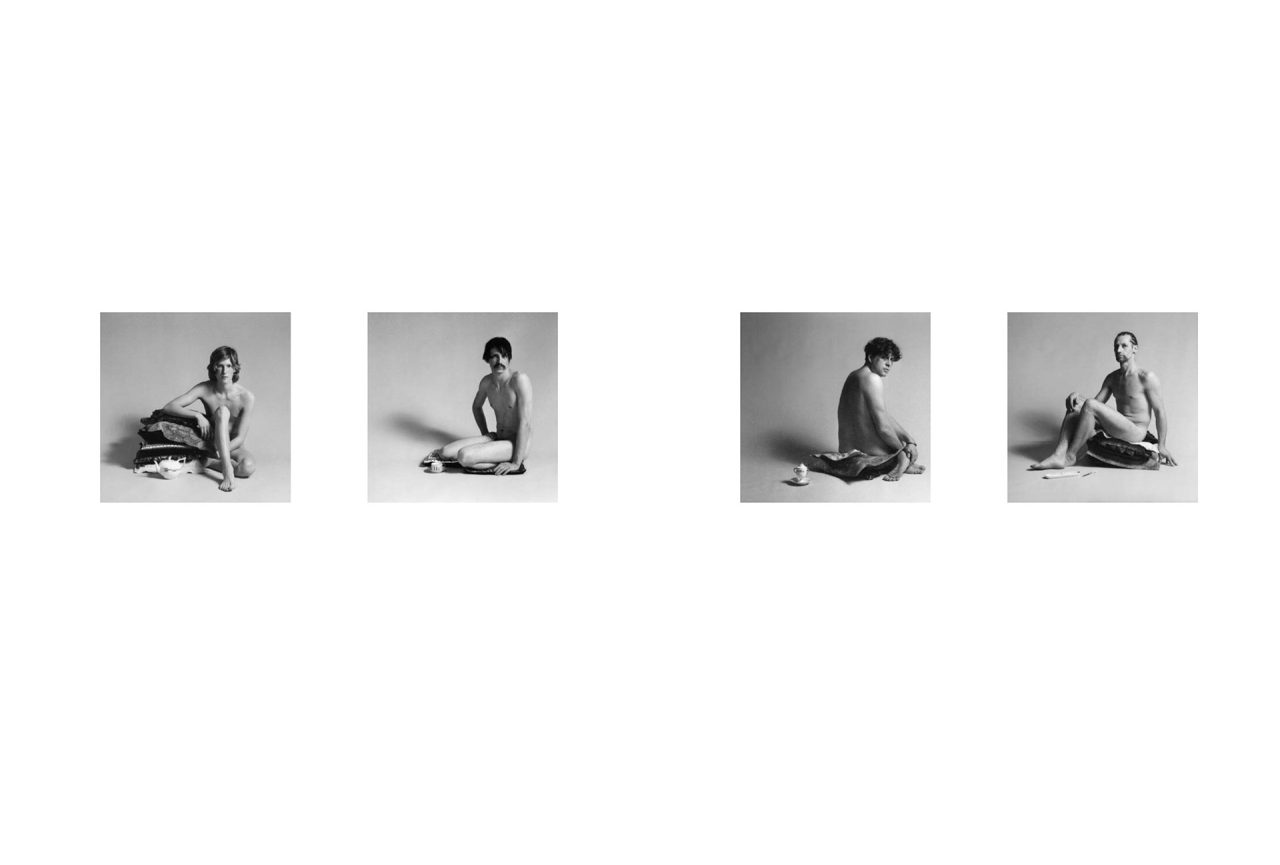
‘Naked men with porcelain’ Partly published in Self Service, March / 2001, Photographer: BLESS
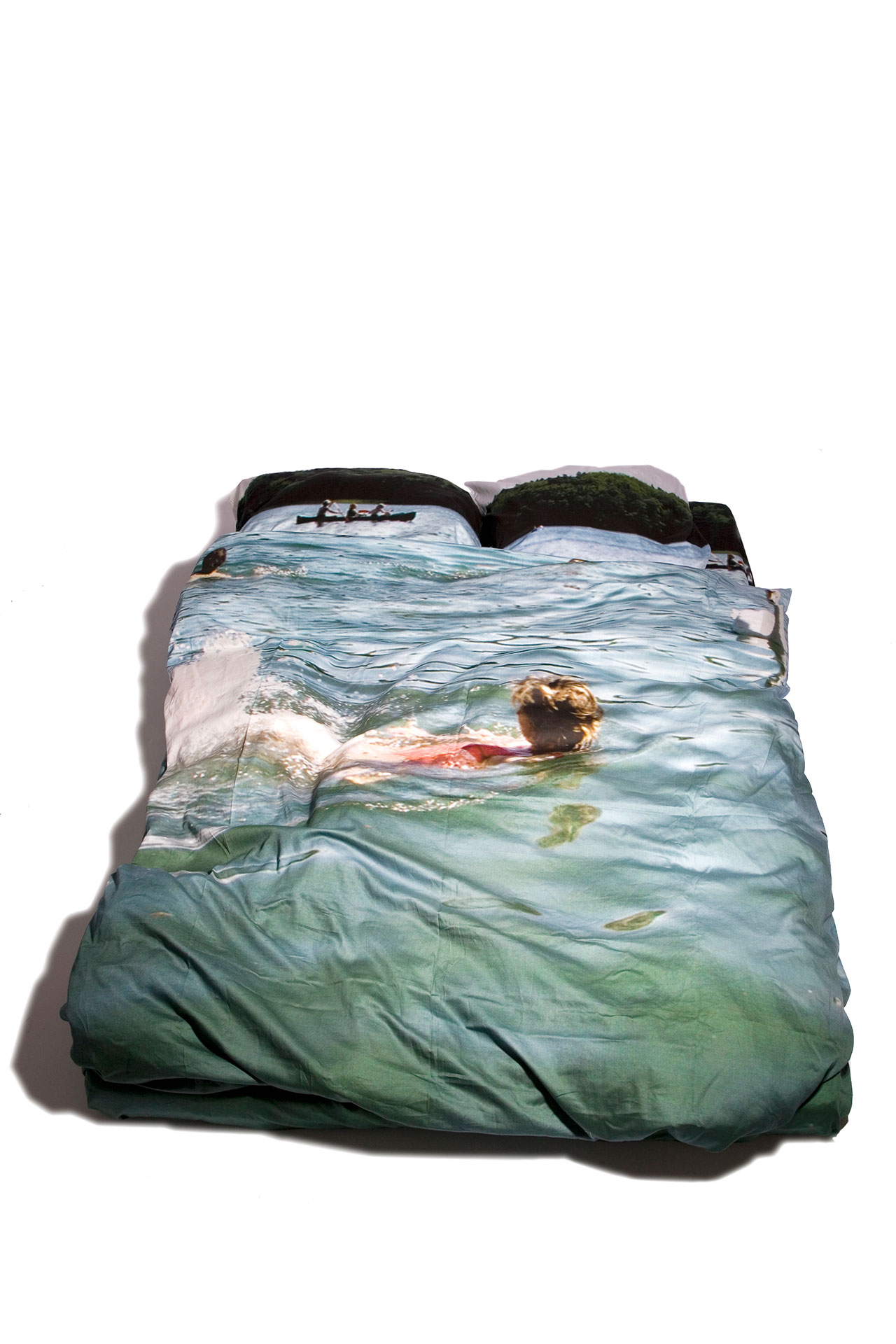
BLESS N°39 / Heart Ringers, Bedsheets Lake / 2009, Photographer: BLESS
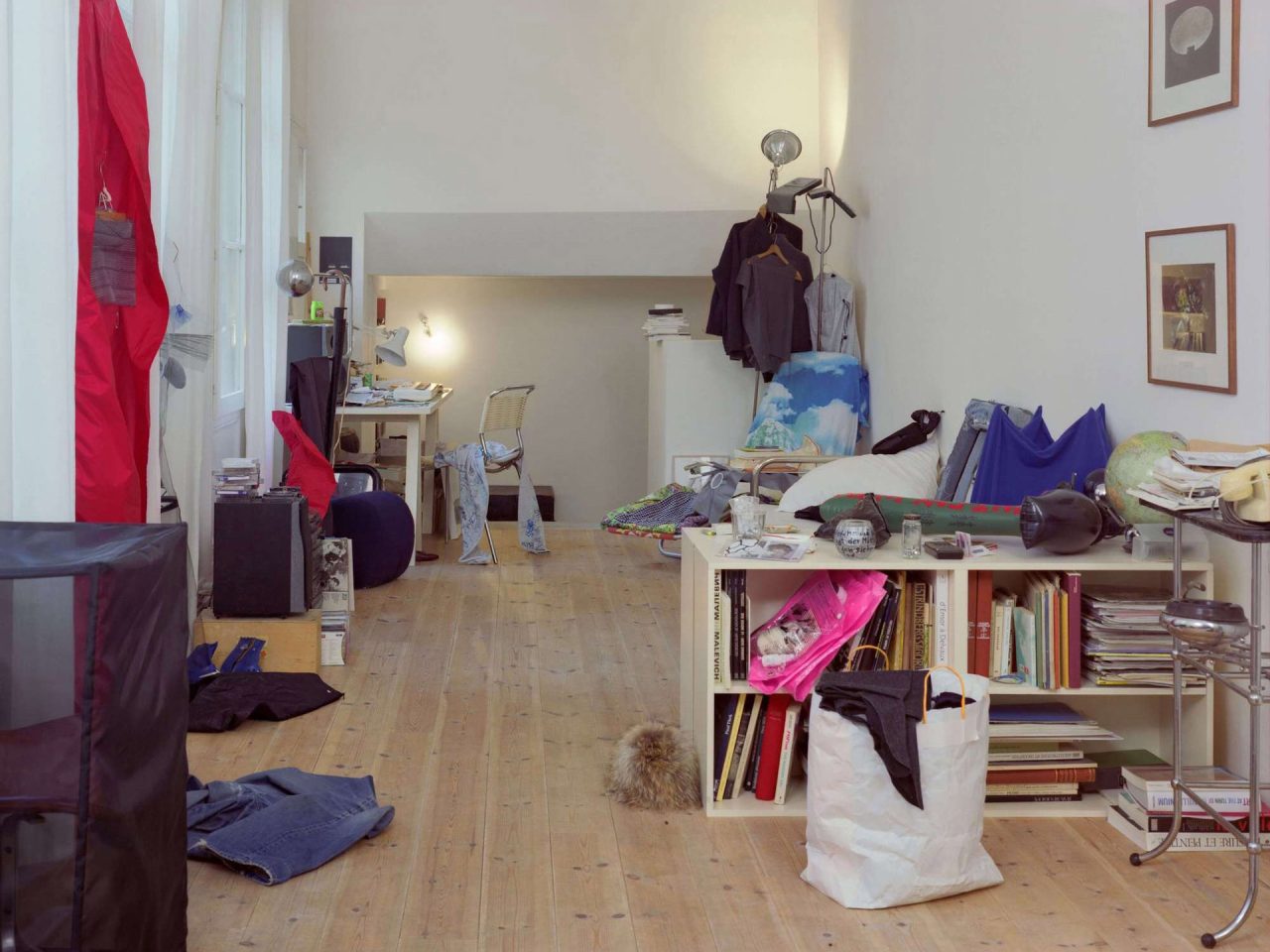
BLESS N°29 / Wallscapes / 2006, Photographer: BLESS
—2023年に BLESS が来日した際には、日本の BLESS ファン、友人たちを招いて、アニヴァーサリーウォークを行いました。特に印象に残っている出来事や、思い出深いエピソードがあれば教えてください。
散歩の途中でいくつか立ち寄り先を設ける計画を立てていた際、ルート上にドイツのベーカリーがあることに気が付きました。私たちは二人ともドイツ南部の出身だったため、その地域を代表する食べ物であるプレッツェルを、散歩の合間に食べる手軽な軽食として用意できるのではないかと考えました。しかし、実際にはそう簡単にはいきませんでした。まず、そのベーカリーのオーナーは旧東ドイツ出身で、大量にプレッツェルを作ることにあまり乗り気ではありませんでした。さらに、完成したプレッツェルも、私たちが故郷で親しんできた味とはかなり異なっていました。南ドイツで慣れ親しんだプレッツェルの味わいには及ばず、どこか期待していたものとは違っていたのです。
—日本では BLESS の取り扱い店舗が現在最も多いと聞きました。日本の BLESS ファンたちのコミュニティは、より幅広い年齢層に広がっているように感じます。他国とも共通することかもしれませんが、お二人にとって、日本のユーザーはどのように目に映りますか?
それは、私たちにとってこれ以上ないほどの褒め言葉です。私たちは、ただの「デザイナー」であることを拒んできました。なぜなら、あらゆる人々とフラットにつながるための適切な方法ではないと思っているからです。私たちの作品はどうしても高価になってしまうことがあり、一部のセレクトショップなどを通してしか届かないこともあります。それは残念なことでもあるんです。
私たちはユニセックスなものづくりをしていますし、年齢やジェンダー、バックグラウンドを問わず、さまざまな人たちのためにデザインできることを嬉しく思っています。いつも大きな夢を描いていて、「もし世界を新しく作り変えることができたら?」というようなことを考えているんです。だからこそ、異なる世代や経験を持つ人たちに届くことは、とても大切なことだと思っています。これまでを振り返ると、日本のマーケットはいつも温かく、美しく受け入れてくれています。日本の人たちが BLESS を理解し、評価してくれることは、本当に嬉しく、光栄なことです。25周年イベントを開催した時も、とても感動しました。そこにいたのは単なる消費者ではなく、長い年月をともに過ごしてきた仲間のような人たちだったんです。日本では、人々が自分の意志で BLESS を選び、受け入れてくれている。それは本当に特別なことです。
日本文化は、個人的にもとても近いものに感じますし、自分たちがやろうとしていることと相性が良いと感じています。合気道やおもてなしの所作にも見られるように、日々の暮らしの一部となり、人生を豊かにするものをつくるという考え方があります。そういった日本文化のあり方は、私たちが目指していることと見事に重なる部分があります。また、日本の皆さんのカルチャーには、たとえ複雑で難しい物事であっても、時間をかけて本質を理解しようとする深い姿勢があると思います。今の世の中、そういった忍耐強さが失われがちな時代でもあるからこそ、私たちの作品をただの服としてではなく、その背景まで大切にし、理解しようとしてくれる日本の人たちと一緒に仕事ができることを、とても幸運に思っています。本当に感謝しています。
—コラボレーション (協働)、そしてカンバセーション (対話) は、BLESS の活動の軸となっているように感じます。『BLESS celebrating 25 Years of Always Stress with BLESS N°42-N°74』では、BLESS を愛する仲間たちの写真がコラージュで表現されていますが、彼らの存在は BLESS にとってどのような存在ですか?
自分たちの仕事が実際に人々の生活の中で生き続けていることを見るのは、私たちにとって何よりも大切なことです。そして、人々が BLESS のプロダクトを通して互いを認識し合い、「ユーザー」としてつながっていること、さらには時に職人的な共同制作者として、ある BLESS のプロダクトの制作に関わっていることを実感できることは、大きな喜びです。
私たちにとって BLESS は単にモノを販売するブランドではありません。プロダクトを介して人と人が出会い、関係性が生まれ、ときには制作のプロセスそのものに参加する。そのような生きたコミュニティや交流が生まれることこそ、BLESS の活動の本質的な価値なのです。

the image from BLESS: Celebrating 25 Years of Always Stress with BLESS N°42–N°74 (BOM DIA BOA TARDE BOA NOITE / 2023), Photographer: BLESS
—BLESS でインターンシップを経験後、デザイナーとして活躍している方もいらっしゃいますよね。ファッションを志す彼らとの交流の中で、インスピレーションを得ることはありますか?
私たちは、この分野で活動を始めようと勇気づけられたデザイナーがいることを、心から嬉しく、また誇らしく感じています。誰かが自分たちの活動や作品に刺激を受け、新たな一歩を踏み出すきっかけとなっているのであれば、それは私たちにとって大きな喜びです。デザインという領域に挑戦する人々が増え、それぞれの表現を追求していくことを、私たちは純粋に応援しています。
—若い世代に向けて、何かメッセージはありますか?
自分自身の道を、自分で見つけることだと思います。そこにマニュアルはありません。もちろん「もっと努力して」といった一般論を言うこともできますが、それでは退屈でしょう? 最も難しいのは、ただ自分がやろうと決めたことを最後までやり遂げることだと思います。
私たちは、既存の制度やファッションシステムに対して、昔から批評的な視点を持っています。日本の方々は変化や流行にうまくついていっている一方で、どこかまだ西洋の形やシステムをコピーしている部分もあるように感じます。クリエイティブであるためには、人から学ぶことが大切です。自分より年上の人や、経験のある人の話に耳を傾けること。自分とは異なる状況にいる人たちから学ぶことも大切だと思います。例えば、教師という存在の役割も時代とともに大きく変わってきました。今では、テクノロジーの面で自分たちよりもはるかに先を進んでいる学生もたくさんいます。そうなると、「教師であること」とは何を意味するのでしょうか。教師だけが唯一の正解を持っているという考え方は、もう成り立たないと思います。私たちが昔受けてきたような、一方通行の教え方をそのまま続けることは不可能です。これからはもっと対話を開き、互いに学び合う関係を築いていくことが重要だと思います。教えるだけではなく、彼らの現代的なものの見方や生き方から、自分たち自身も同時に学んでいるのです。
今では、あらゆる知識やモノの作り方はネット上にすべて転がっています。調べれば見つけられる。だからこそ、大学や教育機関には、これまでとは違う「新しい役割」が求められているのだと思います。知識を与える場所というよりも、実際に人と人が出会い、交流する場所としての役割です。人と出会い、新しい形で自分の考えを広げていくこと。それは、とても貴重な瞬間だと思います。かつて、学ぶことは時間的な余裕がある人だけのものだったかもしれませんが、今はそのシステム全体が変わりつつあります。
—『Kaleidoscope』のインタビュー*2では「関心の移り変わり」に言及していましたね。30年という期間を通して、お二人はどのように変化してきましたか? どんな些細なことでも良いのですが、最近感じた“新しい気付き”があれば教えてください。
「関心の移り変わり」は毎日起きていますし、願わくはこれからも途切れることなく続いていくものだと思っています。私たちは自分たちの実践を「問題解決型 (problem-driven)」だと捉えています。そのため、大きなことから小さなことまで、解決したい状況や課題を見つけては、それに取り組まずにはいられません。
ところで、この問い自体が非常に大きなテーマです。そのため、一つ二つの見出しだけで答えてしまうのは適切ではないように感じています。それでもあえて挙げるのであれば、創造に伴う責任について、学生や消費者、そして自分たちの子どもたちへの教育について、あるいは固定費や CSV ファイルの管理といったといった日々の実務に至るまで、さまざまなテーマについて語ることができます。つまり私たちの関心は、デザインそのものにとどまらず、創作を取り巻く社会的な責任、教育、経済、運営といった現実的な領域へも絶えず広がり続けているのです。
—昨今では、既存のファッションが描く幻想と “現実” がどんどんかけ離れていくように感じます。BLESS から見て、2026年という時代をどう捉えていますか?
私たちはまず、2026年がまだ半分も終わっていないという事実を意識しています (*インタビュー当時)。BLESS は本質的に未来志向のプロジェクトです。私たちにとって BLESS とは、これから訪れる近い未来を生きる価値のあるものにするための、ひとつのヴィジョンであり、現実に対する代替案のような存在でもあります。言い換えれば、BLESS は単に現在に応答するものではなく、まだ見ぬ未来を想像し、その未来に期待や可能性を見出すための実践です。だからこそ私たちは、常に少し先の時間に目を向けながら活動を続けています。
【注釈】
*1
BLESS Recent History by Olivier Zahm
『BLESS: Celebrating 10 Years of Themelessness N°00–N°29』(Sternberg Press / 2006)
*2
KAREIDOSCOPE
manifesto24.kaleidoscope.media
Photographer: BLESS
—How did Desiree, who was studying in Vienna, and Ines, who was studying in Hannover, first meet and launch the label “BLESS”?
We met back in 1993 on a fashion contest in Paris. Our works happened to be exhibited next to one another, and we immediately found each other’s projects intriguing. What particularly attracted us was the fact that we came from very different educational backgrounds. We exchanged addresses, and that marked the beginning of our friendship. Our first conversation lasted only about three minutes, but we both felt an immediate connection. Nothing especially dramatic happened right after we met, yet our friendship gradually developed through correspondence. It was less an exchange of words than an exchange of images. We got to know one another by sharing visual references. Rather than writing messages such as, “How are you?” or “I’m doing well,” we communicated through the images we chose to send. Since postcards offered very limited space for writing, the images themselves became our language.
Later, we attended each other’s graduation presentations and played important roles in the success of one another’s projects. After graduating, our exchanges became even more frequent. While searching for jobs in the fashion industry, we continued creating together, determined to keep making things. However, those anticipated jobs never materialized. Instead, BLESS was born. The turning point came with an advertisement for “BLESS N°00 Furwigs” that we placed in i-D magazine. The ad caught the attention of Martin Margiela, who commissioned us to create a series of wigs for his Autumn/Winter 1997–98 runway show. Signing that contract ultimately led to the founding of BLESS.
—Living in two different cities, you stayed connected through letters, and that experience later inspired you to create a postcard with every collection. Looking back on your journey from then until now, what kind of perspectives or ideas do you think could only have emerged because there are two of you, rather than just one person working alone?
The sheer fact of starting out something together made BLESS come to life as a meeting point. For us BLESS is not a label or brand or art concept but is a place where we face each other, where our interests intersect. From the very beginning it was clear that what we call BLESS can not be what we would have done individually. Living in two different European cities, the divergence of their cultures left palpable marks over time and certainly contributed to a more complex dialogue based on a broader vision and friction-enriched conversations. The now sometimes-drifting interests are interestingly not leading to separation, such as seen i.e., after long marriages. Instead, these unpleasant disaccords raise curiosity and the next level of negotiations and, in the best of cases, to more mature final statements in form of presented work.
—I read in an article (“BLESS Celebrating 10 Years of Themelessness / BLESS Recent History by Olivier Zahm”) that when you founded the label in 1995, you were determined not to become fashion designers. What were your thoughts on the fashion system at the time? And why did you two deliberately choose “fashion” as your point of entry for expression?
We were NOT interested in the fashion industry and its related codes, such as catwalk shows, models, glamour, and fast living. We were and are interested in clothing as a very personal, direct, and unavoidable factor of influence in all day life.
Naturally our interest extends to further surrounding aspects of inner and outer life.
—How do the two of you divide roles and responsibilities in your creative practice?
Everyone is doing everything. There is no division of roles between the two of us. We built the company together, and we work together on everything—from projects, design, and the composition of collections to business decisions. There are no boundaries, not only between the two of us, but also between the creative and business sides of what we do. For us, these are not separate realms; they are entirely one and the same.
What we are really trying to do is rethink the very notion of a profession. We are not simply a fashion company, nor are we obsessed with constantly producing something new. We are not an art practice, nor are we a brand in the purely economic sense. The direction we take is continually shaped by changing circumstances, including economic conditions. Like a living organism, we move forward together, in constant interaction with many different people.
We have been doing this for more than twenty-five years—not that we have achieved enormous financial success (laughs). But in exchange, we have been able to preserve our freedom. For us, BLESS is closer to a way of life than to fashion.
—In the summer of 1995, collage posters featuring various women (accompanied by a mysterious phone number) were plastered all over Vienna, announcing BLESS’s debut. That year, you released the “Sun Tops”—transparent tops that perfectly concealed only the bust. Could you share the background behind the “Sun Tops” and how you look back on those actions today? Just imagining the scene of those bold, mysterious, and curiosity-piquing visuals plastered all over the city makes my heart race.
There is not much to say: we simply like the esthetics of these transparent striped waistband elastics that are traditionally used in a hidden way to ruffle fabrics. In sewing them together we repurposed them, turned them into a larger surface and they became a fabric. The outcome corresponded to the way we would dress when going out. And at that time already ancient machine for producing laminated identification business card sort of passports triggered the idea of using cut-out model heads that would serve to decorate our bodies in a reprography process to replace our own heads and we got wild with it.
—The “Furwig,” released the following year, appeared in several fashion magazines as advertisements. It’s a well-known story that Martin Margiela, upon seeing it, commissioned the production of this wig for his own show (97/98 AW). How did this piece come to be? It’s also fascinating that “collaboration”—an essential element when discussing BLESS—arose so naturally.
Ines father was a furrier, so she always had pieces of fur in her material stock at home. When gathering during our first “collaboration vacation” after the completion of fashion school and while playing with all kinds of residues of both of our material stock, the fur wig came to life as a product that felt genuine unfamiliar and strange to us. It excited us because it didn´t remind us of anything else we would see or wear at that time.
—Since your debut, you have consistently maintained a policy of not showing your faces in public. In a previous interview, you mentioned that BLESS N°09 Merchandising Stitched Starcut T-shirt was created as a way of persuading publications to feature a BLESS product instead of a portrait of yourselves. Could you tell us more about that idea?
Whenever the media asked us for portraits, we would always refuse and instead try to convince them to publish images of our products. From the very beginning, we had no interest in becoming famous at all. We simply wanted to make products and create things. We kept asking ourselves why the focus was always placed on the creators rather than on the work, the creative process, or the objects themselves. So we would send our products and say, “Could you please publish this instead? This is what truly represents us.”
With N°09, we decided to turn our refusal to show our faces into an idea in itself. At the same time, it became a critique of the media’s tendency to constantly foreground the faces of the people behind creative work. It wasn’t simply that we were shy. In a way, we were quite stubborn about not showing our faces.
Martin Margiela also famously refused to reveal his face, but when we began working, the idea of a designer duo—or a creative team—was still uncommon. The dominant figure was always the individual designer. Simply by working as a pair, we naturally occupied an alternative position. Out of that emerged the fictional character called BLESS.
It would have been easy to say, “This is us.” But we felt it was more meaningful to develop our thinking from that initial act of refusal. People gradually became curious about this fictional figure called BLESS. What we do is ultimately a form of communication, and connecting with the outside world has always been our motivation. So we thought, “Let’s make a T-shirt.” The project could have remained a response directed solely at journalists who kept requesting portraits, but we wanted it to reach a wider audience. That was when the idea of creating a portrait emerged. Rather than simply printing our own faces, we chose to represent an abstract vision of a face shaped by our ideas—a portrait shaped by our ideas rather than by our physical appearance.
That is how N°09 came into being. Over the years, the idea continued to evolve in different forms. Four or five years ago, we revisited the concept through stitched lines, creating an updated version of our faces from twenty years earlier. We reversed front and back, developed numerous variations, and deliberately preserved a degree of ambiguity and confusion.
Twenty years ago, we were two separate individuals. But through working together, we became deeply intertwined, and our everyday lives naturally merged as well. It felt somewhat like a long marriage, or even like having a child together. In that sense, the portrait eventually became a blending of our two faces. At this point, it has become almost like a portrait of our child, something born from the two of us.
—With “Furwig” designated as N°00, subsequent products have been numbered, and by 2026, the series will reach N°82. Please tell us about the “numbering” method you’ve maintained since your debut. By making slight adjustments to previously released items and continuing to include them in your lineup, you’ve avoided excess inventory and pursued an organic approach to production. I also saw a comment stating that the series will conclude with N°100—does the “numbering” have an end?
We simply started – it’s just quite pragmatic and handy – and decided to end with n°100. We can though influence how fast this will happen, how many items will be hosted by one BLESS number and how many numbers are released by year. We are now working on n°83 and the end could come in 17 days in releasing one number per day or it can never come if we decide to release one number every 10 years or if one of us decides to stop or passes away. The quality of BLESS lays in her DNA given by the two of us. Nevertheless we enjoy flirting a bit with the approaching end and try to get ready for this.
—After deciding that BLESS would conclude with N°100, did you notice any positive changes in the way you think or work?
We certainly felt the significance of that decision ourselves. By setting N°100 as a limit, we became much more aware that the number of remaining chapters is finite. Because of that, we were able to focus more clearly on what we truly want to communicate during our lifetime. You can no longer expand endlessly in every direction. Instead, it forces you to think more consciously and more clearly about the themes you genuinely want to pursue from this point forward.
There is another aspect to it as well. Around the same time, we decided to update and rebuild our website, which became a kind of archival process. Seeing all the numbers laid out beautifully in sequence made us realize how fortunate we were to have adopted this numbering system from the very beginning. It made everything easier to organize and gave our work a clear structure. Then we realized something quite simple: we had only ever been using two digits. If we were to take that system seriously, it meant that it would inevitably come to an end at some point.
When we started in 1997, we had already done a rough calculation. We were about twenty-seven or twenty-eight at the time, so reaching N°100 would mean being well into our sixties. Back then, we weren’t even sure we would make it that far. Today, however, that number no longer feels so distant.
Once we passed N°70, we began to feel: “This is what we have done, and this is what we still have to do.” It started to resemble a tangible timeline—something tangible. In that sense, it became a tremendous source of motivation.
—Your three monographs and website perfectly archive your work from your debut to the present. Could you share your thoughts on the importance of archiving? (I’m thrilled to learn that items from decades ago are still available for purchase on your website.)
For the moment we are still in the process of making and documenting. What looks like an archive is the attempt to give structure where we need it. Our early numbering is a good help here and we catalogue mainly for ourselves, to be able to track and find things. This may explain why our website is a permanent construction site.
—Not getting caught up in the fast pace of the world, pausing from time to time to establish and uphold our own values. It’s easy to say, but not everyone can achieve it. For readers who resonate with BLESS’s attitude, is there any advice or insight you would like to share?
No advice – we struggle constantly living up to our own expectations. Being patient is one of the most difficult exercises but if it pays (never guaranteed) the calm intensity of the felt reward is priceless.
—In BLESS’s collections, “scenes from everyday life” are often expressed through photo prints. What role does “photography” play in your creative process? I’d also like to ask about the “BLESS photography” series, which was published in independent magazines in the 2000s.
We still adore our photography series and flirted with the idea to work also as photographers. The photographic medium in our case is often a tool that replaces the “action of design by the book” as we like to work with what is here already. We reproduce our reality and use it as a decor for surfaces. It is also a way of archiving and a playful take on “cadavre exquis” when it comes to our “Wallscapes” that are made to show our products in real living situations, or our “Blankets” that document special occasions or scenographic installations.
We still take the posterbook (stillife) pictures ourselves but have limited time capacities at present. Still, we won’t exclude that this part of our work will resurface again at one point.
—When BLESS visited Japan in 2023, you organized an “Anniversary Walk” and invited Japanese BLESS fans and friends. Could you share any particularly memorable events or anecdotes from that time?
When planning several stops during the walk, we figured out that there was a German bakery on the way. Both of us coming from the South of Germany, we thought that brezels, very typical for this part of Germany, could present a quite handy in-between snack during the walk. But it turned out not to be so easy: first of all, the owner, coming from the former East of Germany, was neither very keen to produce these brezels in a larger quantity, nor did they taste of what we knew from our home areas.
—We understand that Japan currently has the largest number of stores carrying BLESS. It also seems that the Japanese BLESS community spans a particularly broad range of generations. This may be true elsewhere as well, but how do Japanese users appear from your perspective?
That is perhaps the greatest compliment we could receive. We have always resisted being seen simply as “designers,” because we do not believe that is the most meaningful way to connect with people on an equal level. Our work can sometimes be expensive, and often reaches people only through a limited number of select stores. In that sense, it is unfortunate that our work is not always accessible to everyone.
We create in a unisex way, and it brings us great joy to design for people of all ages, genders, and backgrounds. We are constantly dreaming big—often asking ourselves, “What if we could reinvent the world?” That is why it means so much to us when our work resonates with people from different generations and experiences.
Looking back, the Japanese market has always welcomed us with remarkable warmth and generosity. It is both moving and deeply flattering to know that people in Japan understand and appreciate what BLESS stands for. When we celebrated our 25th anniversary, we were profoundly touched. The people who gathered there did not feel like consumers; they felt like companions who had shared a long journey with us. In Japan, people choose BLESS of their own free will and genuinely embrace it. That is something truly special.
On a personal level, we feel a strong affinity with Japanese culture, and we believe it resonates closely with what we are trying to achieve. Whether in practices such as Aikido or in the spirit of omotenashi (hospitality), there is a way of thinking that values creating things that become part of everyday life and enrich it. These are not things made solely for museums or institutions. In that sense, there is a beautiful overlap between Japanese culture and our own aspirations.
We also feel that Japanese culture possesses a remarkable willingness to engage deeply with things, even when they are complex or difficult, and to take the time needed to understand their essence. In a world where that kind of patience is increasingly rare, we feel incredibly fortunate to work with people who do not see our work merely as clothing, but who care about the ideas, stories, and intentions behind it. For that, we are truly grateful.
—It feels as though collaboration and dialogue are at the heart of BLESS’s activities. In “BLESS celebrating 25 Years of Always Stress with BLESS N°42-N°74,” photographs of people who love BLESS are presented as a collage. What does their presence mean to BLESS?
It means everything to us to see our work alive and to realize that people have met and recognized each other as “users” as well as sometimes artisanal co-producers of one or the other BLESS-product.
—We understand that some individuals who started as interns at BLESS are now active as designers. Do you gain inspiration from your interactions with these aspiring fashion professionals?
We are genuinely happy and proud to know that there are designers who have felt encouraged to enter this field because of what we do. If our work or our practice has inspired someone to take a new step forward, that is a great joy for us. We wholeheartedly support anyone who chooses to challenge themselves through design and pursue their own form of expression.
—Do you have any message for the younger generation?
I think the most important thing is to find your own path. There is no manual for it. Of course, we could offer generic advice such as “work harder,” but that would be rather boring, wouldn’t it? The hardest thing is simply seeing through what you have decided to do.
We have always maintained a critical perspective toward existing systems and the fashion industry. While people in Japan are remarkably adept at adapting to change and new trends, we sometimes feel that there is still a tendency to imitate Western forms and systems. To be creative, it is important to learn from others. You should listen to people who are older than you and who have more experience. It is equally important to learn from those whose circumstances differ from your own. The role of the teacher, for example, has changed dramatically over time. Today, there are many students who are far ahead of us when it comes to technology. In that context, what does it actually mean to be a teacher? I do not think it is still possible to believe that teachers alone possess the right answers. The one-way model of education that many of us experienced is no longer sustainable. What is needed now is dialogue—a relationship in which people learn from one another. We do not simply teach younger generations; we learn from their contemporary ways of thinking and living as well.
Today, virtually all knowledge and technical information can be found online. If you need to know how something is made, you can simply look it up. That is why universities and educational institutions must develop a new role. Rather than functioning primarily as places that distribute knowledge, they should become places where people meet, interact, and exchange ideas. Meeting people and discovering new ways of thinking through those encounters is incredibly valuable. There was a time when education was perhaps reserved for those who had the luxury of time, but the entire system is now changing.
—In your interview with Kaleidoscope, you mentioned “shifting interests.” How have the two of you changed over the past 30 years? Please share any “new insights” you’ve had recently—no matter how small.
“Shifting interests” are happening every day and hopefully non-stop. Describing our practice as “problem-driven“ we can’t get enough of detecting big or small situations that we want to solve. This question a big one and it does not feel right to hand in headlines for one or two aspects. But in case you insist we can talk about responsibilities for creation by all means, education of students, consumers and our own children, fix-costs and CSV files…
—Today, it often feels as though the fantasies projected by fashion are drifting further and further away from reality. From BLESS’s perspective, how do you view the year 2026?
We notice that 2026 is not yet half over. BLESS tends to be future oriented. BLESS is a visionary substitute to make the near future worth living for.
References
*1
Olivier Zahm, “BLESS Recent History,” in BLESS: Celebrating 10 Years of Themelessness N°00–N°29 (Sternberg Press, 2006).
*2
Kaleidoscope, “Manifesto 24.” Available at: manifesto24.kaleidoscope.media.